Friday, February 05, 2010

2010 Topps Series 1 blaster box break - packs nine and ten, Target Throwback packs


Pack nine - Throwback pack #1
#215 Max Scherzer
#295 Kevin Youkilis
#20 Tommy Hanson

#171 AL Wins Leaders - Hernandez, Verlander, Sabathia
#CMT 56 Dustin Pedroia - The Cards Your Mom Threw Out insert; 2007 Topps.
#WTWY RM Russell Martin - When They Were Young insert; damaged.
#TTT 18 Vladimir Guerrero - Topps Town insert
#117 David DeJesus
Topps Attax code card


Pack 10 - Throwback pack #2
#121 Brett Anderson
#21 Cristian Guzman
#39 Jeff Baker
#120 Jorge Posada

#CMT 46 Pedro Martinez - The Cards Your Mom Threw Out insert; 1997 Topps.
#LL 20 Frank Thomas/Prince Fielder - Legendary Lineage insert
#TTT 7 Josh Hamilton - Topps Town insert
#70 Cole Hamels

2010 Topps Series 1 blaster box break - packs five through eight

Pack five
#18 Tim Stauffer

#79 Francisco Cordero
#298 Baltimore Orioles team card
#294 Adam Dunn

#PP 41 David Wright - Peak Performance insert
#TT3 Hanley Ramirez - Topps Town insert
#262 Homer Bailey
#173 Kendry Morales


Pack six
#57 CC Sabathia
#9 Tim Lincecum
#302 Bean Town Backhand checklist
#WTWY BR Brian Roberts
- When They Were Young insert
#TTT 24 Ryan Braun - Topps Town insert
#264 Arizona Diamondbacks Franchise History - featuring Curt Schilling and Randy Johnson
#85 Ken Griffey Jr.
#308 Robinzon Diaz
Topps Attax code card


Pack seven
#127 Hank Blalock
# 46 Chad Tracy
# 328 Chicago Cubs team card

# CMT 9 Carl Yastrzemski - The Cards Your Mom Threw Out insert; 1960 Topps.
# LL 23 Jackie Robinson/Matt Kemp - Legendary Lineage insert
# TT 11 Brian McCann - Topps Town insert
# 180 Jayson Nix
# 251 John Lannan


Pack eight
#160 Miguel Tejada
#98 Cesar Ramos
#227 Josh Thole

#HOTG 12 History of the Game - First Night Game
#TR 11 Cole Hamels - Turkey Red insert
#TTT 21 Adam Dunn - Topps Town insert
#132 Cliff Lee
#258 Edwin Encarnacion


2010 Topps Series 1 blaster box break - packs one through four

2010 Topps Series 1 blaster box [eight packs plus two Throwback packs with an old-school Topps logo and non-color grey stock backs] - I like the fact there is at least one insert in each pack, though it is merely a small consolation prize, like something out of a Cracker Jack box. 

Pack one
#278 Carlos Delgado
#255 Chris Davis
#54 John Lacknuts [Lackey]

#296 Braves team card
#CMT 53 Alfonso Soriano - The Cards Your Mom Threw Out insert; 2004 Topps.
#PP-15 Alex Rodriguez - Peak Performance insert
#FCTT3 Hanley Ramirez - Topps Town insert [gold]
#320 Brian McCann

Pack two
#52 Billy Butler
#122 Carlos Ruiz

#137 Oakland Athletics franchise history - featuring Rickey Henderson
#33 Adam Moore
#HOTG 14 History of the Game - First Hall of Fame Class Inducted
#TMC-3 Million Card Giveaway - I assume this is a redemption card and not just an information card, though I could be wrong.

Here is how I see this promotion - I redeem the card online to find a 1986 Topps Brett Saberhagen, 1988 Topps Mark Gubicza or a 1991 Topps Jerry Don Gleaton. It is not actually going to be in-hand, though for a fee, the actual card will be shipped to me.

#TT8 Zack Greinke - Topps Town insert
#239 Juan Uribe

Pack three
#330 Brandon Allen
#191 Mat Latos

#TOG-23 Manny Ramirez - Tales of the Game insert
#LL 13 Reggie Jackson/Adam Dunn - Legendary Lineage insert
#TT22 Andrew McCutchen - Topps Town insert
#229 Daniel McCutchen
#166 Eric Byrnes
#285 Kurt Suzuki


Pack four
#109 Justin Masterson
#220 Randy Johnson

#106 NL ERA Leaders - Carpenter, Lincecum, Jurrjens
#CMT 32 Ryne Sandberg - The Cards Your Mom Threw Out insert; 1983 Topps.
#TR 27 Edwin Jackson - Turkey Red insert
#TT14 Albert Pujols - Topps Town insert
#47 Brad Penny
#125 Ichiro

2010 Topps Series 1 blaster box break - Commemorative Patch Card

2010 Topps Series 1 blaster box [$19.99 each] - I needed to satisfy my 2010 baseball card fix and eagerly wanted to get to a local Target once I got back to the U.S., after I'd spent three weeks abroad in the island nation of Philippines for a sort of a homecoming / vacation.

Commemorative Patch Card
MCP 21 Orlando Cepeda - 1967 World Series Commemorative patch; two dinged corners, a pin-sized tear on the right hand side of the card. The card looks cheap because the area where the manufactured patch glued on is just grey stock cardboard.

A manufactured patch glued onto faux cloth material would look better than one left the way it is on these patch cards - the manufactured patch already looks shabby and now the rest of this year's cards looks homemade and produced to get a lot of the cards out into circulation.

Monday, January 11, 2010

Mark McGwire - a plight of a tainted man looking for redemption

I'm not so much worried about the details and what Mark McGwire may have not said in his statement or to Bob Costas in their MLB Network interview - regarding his use of steroids and PEDs.

With McGwire's admission, at least now there is finally some transparency - we don't need to know what McGwire was using and when he was using. Just getting him to admit to using steroids and PEDs means a whole lot more than if he'd continued to sit back and be ignorant of his situation.

Of course, McGwire needed to talk about the past, in order to move ahead with his new position as hitting coach with the St. Louis Cardinals - I believe he sincerely wants to be the best hitting coach in the Major Leagues and he doesn't want any distractions from the media. 

I'm happy McGwire confessed because now we can go look at his numbers and make our own conclusions as rational thinking baseball fans - to whether or not PEDs helped him with his God-given ability to hit a baseball.

Just like with Alex Rodriguez' admission, there is some timeline of PED use established and those who can vote for players to be inducted can kind of figure out where McGwire's numbers stand - with their own subjective standards of what is a great player and what is a Hall of Famer. 

Admitting his use of steroids and PEDs might serve as closure for McGwire - he might want to see it that way.  

However, if McGwire doesn't say more than what he has already admitted to - he still has a long way of garnering the support of anyone who can legitimately argue his numbers as Hall of Fame quality and can actually vote on the matter.

Sunday, January 10, 2010

2009 Bowman Draft two-pack $2.99 Target breaks

Pack one
BDP 50 Kyle Blanks
BDP 44 Diory Hernandez
BDPP 6 Christopher Lovett - Chrome
BDP 43 Brent Leach - Chrome
BDPP 11 Brooks Pounders
BDPP 5 Josh Hodges
BDPP 45 Mycal Jones - Gold parallel

Pack two
BDP 54 Josh Reddick
BDP 33 Tim Wood
BDP 3 Trevor Bell - Chrome
BDP 45 Wilkin Castillo - Chrome; apparently this a blue retail exclusive refractor.

The blue refractor is nice, though I doubt is going to be a hard to find parallel and the card I pulled doesn't feature a hotshot rookie or an up-and-coming non-autograph prospect - I like the colors on shiny chrome parallels, though I honestly never consciously collected them, whether it was from Topps Chrome or Bowman products. I think they scratch too easily and are too condition sensitive.

BDPP 29 James Jones
BDPP 21 Kent Matthes
BDPP 72 Brian Moran - Gold parallel / does this card compare to this? Bum-face!


I found nothing too exciting in the packs, though I was pleasantly surprised, even for only two lousy packs - I didn't find one WBC card, since those cards are not what Bowman Draft product is supposed to be about.  

I was  kind of looking for a random Brent Leach card to get signed in-person or through the mail - I like the Trevor Bell too, since it is another card I can attempt to get autographed in-person or through the mail, even though his rookie cards came out in 2005.


Goodbye Vlad

It was decided a while ago that Vladimir Guerrero wasn't in the Los Angeles Angels plans for 2010 and beyond - now, he is close to signing with the Texas Rangers, an American League West opponent of the Angels. 

It was fun watching this guy hit in an Angels uniform - hopefully Vlad acquiesces to some fans requests to see him up close and to say thanks for all the dazzling numbers he put up as Halo. 

When he comes back to play his first game as an opponent at Angel Stadium - a standing ovation before Vlad's first at-bat would be something memorable he should take in regardless of how things ended in Anaheim.

Saturday, January 09, 2010

Baseball busts and disappointments - No. 1 Drew Henson

Here is my retrospective on 10 busts and disappointments over the last 10 years - Drew Henson was an easy choice for No. 1, since he managed to flop in two professional sports after being highly touted super-athlete in high school/college.

1.) Drew Henson - played one too many sports and had one too many holes in his swing. He was destined to be either John Elway as a quarterback or perhaps Scott Rolen as a third baseman.

In the minor leagues, Henson was exposed as having too many holes in his swing and after bouncing back-and-forth between the New York Yankees and the Cincinnati Reds - he decided professional football was his true calling.

However, Henson washed out as a second or third string clipboard holder in the NFL as well - never really becoming a very good professional baseball player or a decent professional football player.

When he was initially a hot commodity back in the late 1990s - his hottest card was a 1999 SP Prospects Minor League card, which was perhaps a $10-$20 card at one point.

It is hard to believe a minor league base card that was available in packs would command some value - I don't recall the furor over the card, though part of the hype was due to Upper Deck releasing the card while Henson was still playing football at Michigan.

Now the card is worth about a quarter or less and is a reminder why hobby hype over two-sport stars simply isn't warranted - over a comparable player who focuses on one sport, whether you are a football card collector or a baseball card speculator.

BUST

Baseball busts and disappointments - Part III

Here is my retrospective on 10 busts and disappointments over the last 10 years - it really isn't my point to make fun of these players' accomplishments, but as a baseball fan who at times likes to speculate on the future stars, sometimes I wonder what happened to these guys that were supposed to be at least perennial all-star talent.

4.) Jesse Foppert - was the next Tim Lincecum, several years before Lincecum was drafted by the San Francisco Giants. Foppert was bigger and had the ideal projectable pitcher's body, but injuries [i.e. Tommy John surgery] apparently derailed his promising career. He ended up bouncing around in the minors, unsuccessfully trying to regain his footing as a professional.

BUST
3.) Eric Munson - he was the No. 3 overall pick out of USC in 1999 and while his rookie card was actually in the 1999 Upper Deck Ultimate Victory product, it meant a little something to me when I pulled a 2000 Upper Deck card since I thought he was a future star. Now I just look at his career and think as perfect of a life this guy may have being paid to play professional baseball and all the fringe benefits playing in parts of nine Major League seasons has brought him, the journeyman catcher still has a lifetime batting average of .214 and little to show for his high draft pedigree.

BUST

2.) Joe Borchard - another two-sport star, I was excited when I sent him an autograph request through the mail back in 2000 and he sent me a signed minor league card. It is too bad, he never quite figured things out with his Major League 'slash lines' at .205/.284/.352 in 716 at-bats, covering 301 games in parts of six seasons from 2002-2007.

BUST

Friday, January 08, 2010

Baseball busts and disappointments - Part II

Here is my retrospective on 10 busts and disappointments over the last 10 years - I'll label the guys who weren't outright busts as disappointments, particularly if injuries seemed to be the biggest factor in them not being able to have successful Major League playing careers.

7.) Austin Kearns - Kearns and Adam Dunn were supposed to form some kind of duo with the Cincinnati Reds. Kearns was seemingly the better all-around player and Dunn could hit for crazy power. However, Kearns really filled out too much at some point in his career and became more of a one-dimensional plodder, never really quite fulfilled his potential.

While he still has some skills and maybe still be useful player - he has been dinged by injuries the last couple of seasons and his numbers have suffered.

DISAPPOINTMENT

6.) Alex Escobar - a five-tool outfield prospect, he was supposed to be the next New York Mets' superstar. However, after moving onto some other teams, a rash of injuries derailed his promising career and he couldn't stay on the field for a prolonged period of time to put up some decent numbers.

DISAPPOINTMENT

5.) Ruben Mateo - he was looking like a future all-star performer, but after he broke his femur in 2000, was never the same player and ending up being a journeyman.

DISAPPOINTMENT

Baseball busts and disappointments - a Top 10 list from the last 10 years

Congratulations to Andre Dawson and his election to the Hall of Fame - for us fans and baseball experts who debate whether or not a player of his caliber is worthy of induction, it doesn't matter because Dawson is in the Hall of Fame.

On the other hand, there are talented players who don't have one-third a career Dawson has enjoyed - it is kind of fun to poke around and see the once highly touted players coming up the professional ranks, only to hit a wall at the Major League level.

My original definition of a bust is a player who fails to reach the Major Leagues after having some sort of hype thrown at his direction - if a particular player reaches the Major Leagues, then the player should be considered a professional success. On the other hand, if he did little once he got to the Majors, then he has to have the label of a 'bust.'

However, if the player never really fulfilled any sort of expectations after reaching the Major Leagues - I'd like to believe the player is still a bust.

However, there are certain players who didn't live up to expectations after being hyped up as top prospects - being labeled a disappointment isn't the worst thing if a player has had at least a useful three or four year Major League career and has survived to play in the Major Leagues for a period of time.

Here is my retrospective on 10 busts and disappointments over the last 10 years - I've got a small stack of their cards filed away just to remind me not to believe the hype, whenever a hotshot baseball prospect [Stephen Strasburg in the pros or in the amateur ranks, Bryce Harper] is being bandied about as the next all-star or superstar.

10.) Dallas McPherson - as Angels fan, McPherson leaves a bitter taste because of the injuries ravished his career. He a 'country strong' hitting prospect, who tore through the minors and was supposed to be Troy Glaus' replacement. On the other hand, even though he was a crown jewel of the Angels' system, he was sort of an 'older prospect' who had holes in his swing. Regardless, if healthy, I thought he could hammer any flaws out and don't see him as a complete flop.

DISAPPOINTMENT


9.) Adam Johnson - the second overall pick in the 2000 draft, the Cal State Fullerton product's lone cup of coffee in the Major Leagues in 2001 included allowing 23 earned runs in 25 innings. I remember Phil Nevin and Mark Kotsay as the most highly decorated and touted CSUF baseball players in the last 20 years, but I don't know if I actually followed Johnson at CSUF to even consider him in the same class with the two.

Maybe he snuck up on people and turned out to be a guy who'd be easier to sign than others available
- the Minnesota Twins had better luck in 2001 when they picked a guy named Joe Mauer No. 1 overall, who was also tabbed an easier sign, than the consensus No. 1 talent in Mark Prior.

BUST

8.) Kenny Kelly - a two-sport star, his athleticism never translated into something decent as a pro baseball player and he never got a prolonged opportunity to stick in the Major Leagues after making his MLB debut with Tampa. I remember trying to pick up a couple of his cards on eBay, thinking he might actually some kind of good player.

BUST

Monday, January 04, 2010

Considering the Hall Candidates - Andre Dawson

Andre Dawson

Pro - he was a multitalented outfielder who was the 1977 National League Rookie of the Year with the Montreal Expos.

An eight-time Gold Glove winner, playing in Montreal diminished Dawson's abilities because apparently Astroturf was fake, synthetic grass layered over cement - it did much damage to Dawson's knees and hindered his ability to run and field over time, despite finishing with 314 stolen bases in his playing career.

Dawson and his agent apparently negotiated a 'blank' check after 10 years in Montreal and signed on with the Chicago Cubs - despite playing for a last place team, Dawson hit 49 home runs and had 137 RBIs in his 1987 National League MVP season.

Dawson was four-time Silver Slugger winner who hit 20 or more home runs in 13 of 21 seasons in the Major Leagues - finishing with 438 home runs and 1,591 RBIs.

Con - a player with a .323 on-base percentage may have been a little more patient and take his walks but one lone number shouldn't define the type of ballplayer Dawson was.

Yes/No - I would lean towards 'yes.'

Citing his on-base percentage seems to marginalize Dawson's relevance when he was an active player - he found a way to succeed despite his .323 on-base percentage and being one of the best all-around outfielders during his time, he cannot be denied longer.

Considering the Hall candidates - Tim Raines

Tim Raines

Pro - he might have been the best lead-off hitter of his generation, if Rickey Henderson wasn't running away with all the headlines.

On the basepaths, Raines stole 808 bases in his career, including six seasons of 70 or more steals - he also scored 1571 runs. 

At the plate, Raines got on-base via the walk 1330 times and collected 2605 hits - he was in the Top 10 in on-base percentage seven times during the 1980s and his lifetime on-base percentage was .385. 

Raines won the 1986 batting title with a .334 mark - his career batting average was .294.

An apparent cocaine addiction didn't stop Raines as his career peaked in the mid 1980s - through the decade, he was a seven-time All-Star and was the 1987 All-Star MVP. 

Con - Raines was an exciting player, but was overshadowed by Henderson, particularly when Raines was playing in Montreal. 

Oakland wasn't Montreal and more importantly, that time around the early 1980s - the A's had gained some notoriety with "Billy Ball," with Henderson to focal point of an upstart team in the Bay Area.

Raines played on World Series championship teams with the New York Yankees in 1996 and 1998 but in comparison to Henderson, who won the 1989 ALCS MVP - Raines was never the lone dominant player in one postseason series.

Yes/No - I'd lean towards 'no.'

Would it be a reasonable thought that hanging around for four or five more seasons until he was 42 hurt his Hall of Fame chances just a little bit - Raines was a pretty good player for a long time, but his star seemed to shine the most in the 1980s and by the mid 1990s, had faded into relative baseball obscurity as a part-time bench player.

Considering the Hall candidates - Roberto Alomar

Roberto Alomar

Pro - was the dominant player at second base in his prime with a sterling reputation as a slick fielding defender at second base and an offensive force at the plate. 

Alomar was arguably the best player for back-to-back World Series championship teams with the Toronto Blue Jays - winning the 1992 American League Championship MVP.

He stole 474 bases and was a constant threat - at the top of the lineup. 

His lifetime hitting marks include winning four Silver Slugger Awards - and finishing his career with 2724 hits.

His other lifetime batting marks include a .371 on-base percentage and a lifetime .300 batting average - Alomar had 504 doubles and hit 210 home runs with a .443 lifetime slugging percentage. 

Con - Alomar spat on an umpire in 1996, leaving a permanent stain on his accomplishments, altering the perception of him that still lingers among fans, the media and maybe those in the game.  

The year 2001 was the last great season for Alomar, but he was still looking to be on his way to getting 3,000 hits - however he ended up bouncing around as the latter part of his career careened off a cliff and was forced to retire without reaching the milestone.

Personal problems bubbled up for Alomar in 2009 - when an ex-girlfriend filed a suit against him with claims Alomar had exposed her to AIDS.

Yes/No - I'd lean towards 'yes.'

Reading about how Alomar's career crumbled in his last few seasons was disappointing - and reading accounts of his ex-girlfriend's claims was particularly disturbing. 

However, Alomar shouldn't judged by rumor and innuendo - as a 10-time All-Star and a 10-time Gold Glove winner, his accomplishments on the field speak for themselves.  

Considering the Hall candidates - Bert Blyleven


Bert Blyleven

Pro - he has nearly 300 wins and over 3,000 strikeouts in his resume. 

By his account - he's probably the most deserving of all eligible candidates and should have been inducted already.

Blyleven made 685 starts in 692 games pitched in the Major Leagues - he was a durable workhorse who took the ball and pitched 242 complete games, including 60 shutouts in the process.

It boggles mind to consider his innings workload during his prime in the 1970s to be 'normal' for a pitcher
- which all the more impressive considering Blyleven statistics as it relates to how good a pitcher he was, regardless of any negative sentiment i.e. he pitched for bad teams, was more of a compiler, wasn't really ever great in one particular season, etc.

Aside from Blyleven's numbers, Blyleven was considered to be a good natured, fan-friendly player - who was a notorious, prankster in Major League clubhouses.

Con - what makes him so different from other comparable hurlers? However, he may come off as a little too smug and a little too ardent in campaigning for his spot in the Hall of Fame, particularly in the last four or five years, where he has gained more support.  

He has the numbers, but maybe those who don't vote for him were exposed to Blyleven - as some sort of clown who was a better clubhouse prankster, than a Hall of Fame caliber pitcher.

Yes/No - I'd lean towards 'yes.' 

He's waited long enough to be honored maybe he should be recognized for his accomplishments and not his humility - circle me, Bert.

Considering the Hall candidates - Fred McGriff

Fred McGriff

Pro - McGriff's prime was during the late 1980s and early 1990s as he clubbed 30 home runs for seven straight seasons from 1988-1994.

He propelled the Atlanta Braves in their chase to win the National League West championship in 1993 - the last real pennant race.

He slugged 30 or more home runs in 10 of 19 seasons - he led the American League with 36 home runs in 1989 and the National League with 35 in 1992.

He finished with 493 home runs and 1,550 RBIs.

He finished with a .377 on-base percentage and a .509 slugging percentage.


Con - McGriff's numbers are easy to ignore, because as the power numbers exploded through the mid 1990s, there was no real 'jump' in The Crime Dog's home run totals.

While sluggers of comparable ability were slugging past his best home run totals on a perennial basis - McGriff wasn't hitting 40-50 home runs like everyone else through the mid to late 1990s.

Yes/No - I'd lean towards 'yes.'

McGriff's legacy will forever be linked for endorsing Tom Emanski's baseball instructional videos
- McGriff was a great slugger and if he had starred from the 1970s and early 1980s, maybe the consistency in his power numbers would be seen with more relevance.

Considering the Hall candidates - Dave Parker

Dave Parker

Pro - 'The Cobra' had some fine seasons and was arguably the dominant player in the National League from 1975-1979, when he won three Gold Gloves [1977-1979] in right field and was the 1978 NL MVP.

Parker was among the Top 10 leaders in slugging seven times - he led the National League with a .545 mark in 1975 and a .585 mark in 1978.

Parker's .339 on-base percentage was a little better than Andre Dawson's .323 - Parker didn't rack up 90-100 walks a season, but due to high batting averages, had three seasons where he had .397 on-base percentage [1977], .394 on-base percentage [1978] and .380 on-base percentage [1979].

Parker finished his career with a .290 batting average, 339 home runs, 1493 RBIs and 2712 hits.

Con - Parker was caught up with a drug scandal in 1980s and his numbers were dinged by a combination of a strike, injuries and age. 

Yes/No - I'd lean towards 'no.'

A seven time all-star and the 1979 All-Star MVP, Parker was a great player in his prime and a case can be made that he is a borderline Hall of Famer - if Parker he'd reached 3,000 hits, he'd be in the Hall of Fame. As impressive as his accomplishments are, his final numbers doesn't quite vault him from Hall of Very Good status.

Sunday, January 03, 2010

Considering the Hall candidates - Jack Morris

Jack Morris

Pro - if there was a Hall of Moments, he'd be in along with someone like Roger Maris, particularly for his performance in Game 7 of the 1991 World Series, where he gutted out a series clinching performance with 10 shutout innings over the upstart Atlanta Braves.

He pretty impressive in the 1984 World Series for the juggernaut Detroit Tigers with - two wins, 18 innings pitched, allowed four earned runs and struck out 13 against only three walks.

The winningest pitcher in the 1980s, Morris started 527 out 549 games in his Major League career and was a workhorse - he completed 175 games along with 28 shutouts.

Con - there seems to be more of a quantity rather than quality aspect to the numbers he put up. He probably got another ring with the Toronto Blue Jays in 1993, but imploded with a 7-12 record and 6.19 ERA. He got pounded for 189 hits in only 152 innings and didn't even pitch in the postseason.

Yes/No - I'd lean towards 'no.' 

If Morris had retired after the 1992 season, maybe his lifetime ERA looks a little better, even with 17 less wins [total number picked up between 1993 and 1994] - maybe he'd look better to voters to see him finish his career with a 21 win season instead of appearing to hang around two seasons too long.

First collecting topics cards added in 2010

1991 Pacific Nolan Ryan # 40 - pitchers hitting

2005 Topps Cracker Jack Roger Clemens #70 - pitchers hitting

2003 Fleer Patchworks Jeff Bagwell #74 - bonus baby / cameo by Barry Bonds

By the end of 2009, I hope to have picked up 500 new collecting topics cards featuring various characteristics - I'm looking for cards with personality because there is nothing like finding a 'fun card' with a unique image or characteristic that is not going to cost much more than a nickel or a dime.

A.) Bonus babies – cards featuring star players who make cameos on mostly common players' cards.

B.) Inking it up – cards featuring players signing autographs.

C.) Unique shots/awesome action – baseball, basketball, football, hockey. Can be posed.

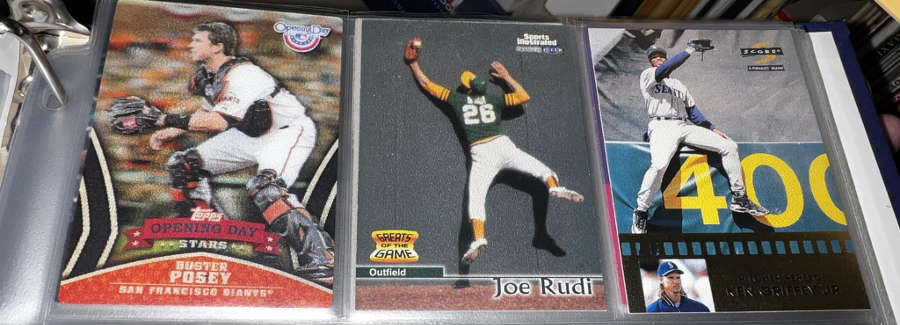
D.) Awesome outfield action – cards featuring players leaping, diving, jumping to grab the ball. Can be posed.

E.) Tools of ignorance – cards featuring catchers, maybe the hardest working players on the field.

F.) Facial hair – cards featuring players who are wearing beards, goatees, porn-mustaches, et al. 

G.) High-toppers – cards featuring players players sporting high-top socks.

H.) Grips – cards capturing pitchers' grips during their delivery. 

I.) Unique backs – cards detailing something a fun fact or a feat. 

J.) Two-sport stars – cards of professional athletes who've been known to have played in other sports. 

K.) Cult baseball players/unique feats – cards of baseball players who were considered quirky, a good quote, a little kooky, looney, attracted a unique fanbase, some notoriety or have actually done something unique on the field.

L.) Hats-off – cards featuring players without their hats on.

M.) Players smiling – cards featuring players smiling or hamming it up for the camera.

N.) Pitchers hitting – cards featuring pitchers hitting, running the bases or wearing batting helmets, about to step up to the plate.

O.) Retro uniforms – cards featuring players wearing turn back the clock jerseys/uniforms.

P.) Broken bat shots – cards featuring hitters breaking their bats. 

Q.) Beyond the glory – cards featuring players who have battled addictions, battled career threatening injuries, mental problems, et al.

R.) Uncorrected errors – virtually worthless, but still unique to have a card with a name mispelled or a card with the wrong player pictured, et al. 

S.) Steroid Era / PEDS – cards of players who were busted, suspected, reported, outed, et al. 

Collecting topics that can go on forever – 

A.) Bloodlines [actual and loosely related] – cards featuring players who are related to another player as a cousin, father-son, stepson, wife, odd bloodlines [a player is related to someone in another sport or non-sport endeavor], et al.

B.) Local players [Orange County, California] – cards featuring players local to the county, high school or college. 

C.) Nations – sorted by country

D.) Infamous – all sorts of professional athletes who have been known [or not known] to have done something notable in their careers.

Considering the Hall candidates - Mark McGwire

Mark McGwire

Pro - MCgwire was the dominant home run slugger of his era, the main attraction for a sport reeling from a strike in 1994. Along with baseball's Michael Jackson [well, that is who Sammy Sosa resembles these days], McGwire helped reinvorated the game with their home run hitting exploits back in 1998.

He hit 49 home runs as a rookie in 1987.

He finished with 583 home runs and drove in 1414 RBIs.

His lifetime slugging percentage was .588 and his on-base percentage is .394.


Con - he may have always had the ability to hit for power, but through nine seasons and the age of 31, he only had 238 home runs, his lifetime batting average was .250 with only 834 hits.

After injuries in 1993 and 1994, which seemed to signify his Major League career was basically over - it was suspicious, he would enjoy a career surge seems suspicious for a guy who had all-star ability from the beginning of his Major League career, but not quite the sustained greatness expected from a potential Hall of Fame
candidate.

There are fans, members of the media and baseball experts who probably believe while McGwire used something
- he never touched one PED that helped him put up seasons where he hit 39, 52, 58, 70 and 65 home runs from 1995 through 1999.

His reluctance to speak at the congressional hearing back in 2005 seems like a smoking gun as far whether or not he used - "I'm not here to discuss the past," or, "I'm here to be positive about this subject."

Yes/No - I'd lean towards 'no.'

Maybe the PEDS helped a player like McGwire sustain his health and a rational can be justified about wanting to be healthy to play a game one loves and is getting paid for
- on the other hand, any possible drug use may have propelled a player like McGwire's career into unnatural heights during the Steroid Era.

If baseball fans and the media are really interested in holding the players accountable for cheating
- someone like McGwire should probably be looked upon as the biggest fraud.

Considering the Hall candidates - Lee Smith

Lee Smith

Pro - once was time the all-time saves leader, Smith racked up 478 saves in a 18 year career. He had 30 or more saves in 10 seasons and 40 or more saves in three of those seasons.

Smith was an intimidating figure 6'6" but never really had the 'signature theatrics' of a modern-day closer from the last 30 years - it seemed like he was the time who went about his business closing games out and then had a beer after the game.

Con - Smith piled up a bunch of saves in the regular season, but in his only postseason appearances in 1984 and 1988, he was 0-2 in four games and was bombed for nine hits and five runs in 5 1/3 innings. If his teams had advanced further than they did in the playoffs, Smith's accomplishments in general would be held in higher regard, especially if he was a closer for a World Series championship team.

Yes/No - I'd lean towards 'no.'

With the elections of Bruce Sutter and Goose Gossage, maybe a precedent has been set to look deeper into role of a closer as far as consideration for the Hall - Smith benefits because he was pretty good for a long time, regardless of how many teams he played for. Unfortunately, his lack of postseason glory with the Chicago Cubs or the Boston Red Sox maybe the reason he is looking in from the outside.

Card show trip - those who try to sell stuff to vendors

I made a token trip to a card shop and while looking through boxes of cards at a booth, I was seeing random people offering to sell things to the vendor - I'm surprised most vendors still look through people's crap, though the vendors are probably looking for some 'bargain buys' as well, so it kind of pays to give a cursory look when someone approaches with some cards to sell.

It seemed depressing to see someone being turned away
- the vendor does have a business and he has the right to be picky. However, am I going to be one of these collectors, expecting something of value, because I'd hoarded all sorts of cards?

It seemed like most of the guys had the wrong cards
- the wrong assortment of years and wrong types of cards, which seems depressing, when you hear someone say they can't take their cards because they are low-end, they aren't of desireable players, etc.

The vendor was patient with most of the guys, who mostly had junky cards from the 1980s through 1990s
- the vendor at the booth was pretty clear he was only buying collections with at least three or four key cards he can actually [make some profit, any profit on].

"Buy me lunch," one of the guys said, a little desperate just to get rid of what he brought.

"The sheets and binder are worth more," the guy at the booth said. "Than the cards inside."


Some guy even had a bunch of cards and random packs [seriously] he was fishing out of a McDonald's bag like a bunch of clowns coming out a clown car
- guy didn't look like he was all there and the cards he was trying to pawn off seemed of dubious quality.

To me, it was just all too sobering - it is better to be a true collector in it for the long haul, than someone who collects because he or she believes cards will be of 'any value.'